Custom Software for Field Service Businesses (HVAC, Plumbing, Electrical, Fire/Water): Build vs. Buy
2026-10-02 · Appsoluty team
ServiceTitan and Housecall Pro run a huge share of the HVAC, plumbing, electrical, and restoration companies you'd call for a quote this afternoon. They handle scheduling, dispatch, invoicing, and enough CRM to keep a single-trade residential shop organized. The field service software build vs. buy decision becomes real the moment that stops being enough: a second trade gets added, a second location opens, or a restoration job needs documentation the platform was never built to produce.
This isn't a platform-quality problem. Both tools are well-reviewed and well-funded, built for the average trades business. The trouble starts once your business stops being average: once your pricebook has logic nobody templated, once a multi-location operation needs reporting across branches the tool treats as separate accounts, or once an IICRC-certified restoration job needs compliance paperwork the platform has no field for.
Why trades businesses outgrow off-the-shelf FSM software
Multi-trade shops feel it first. A combined HVAC and plumbing company often prices jobs differently depending on trade, crew certification, and parts markup, and most flat-rate pricebook tools assume one trade's logic applies to all of them. Multi-location and franchise operators feel it next. They need rollup reporting across sites, not several separate logins that don't talk to each other.
Fire and water restoration companies hit a different wall entirely. IICRC documentation, drying logs, moisture readings, and insurance-carrier paperwork aren't optional add-ons, they're the job itself. Off-the-shelf FSM tools tend to treat them as attachments bolted onto a generic work order rather than a workflow the software actually understands. Construction companies hit a similar wall once multi-crew, multi-site complexity outpaces what a generic platform's templates assume.
None of this makes the tools bad. It means they were built for the median customer, and multiple trades, multiple locations, or compliance-heavy work move you off that median fast.
What ServiceTitan, Housecall Pro, and similar tools actually cover
Core strengths
Scheduling and dispatch are genuinely solid in both platforms: drag-and-drop calendars, technician tracking, automated appointment reminders. Invoicing and payment collection work out of the box, and the CRM layer is enough to track a residential customer's service history and equipment. For a single-trade shop running standard jobs, this covers the operation end to end, and there's no reason to build your own version of it.
Where they stop
The gaps show up in the same handful of places across almost every shop that's outgrown the median:
- Custom pricebook or flat-rate logic that varies by trade, certification, or region
- Multi-location franchise reporting that rolls data up across branches instead of siloing it
- Equipment, warranty, and recall tracking tied to serial numbers and manufacturer data
- Maintenance-contract automation for recurring commercial accounts
- Restoration-specific compliance documentation: drying logs, moisture readings, carrier paperwork
- Deep integration with accounting systems, inventory, or IoT sensor data
A third-party review site's breakdown of Housecall Pro's feature gaps names some of these directly: preventive-maintenance functionality that the site's own scoring rates weak relative to competitors, no inventory tracking, and support built primarily around residential jobs rather than commercial accounts. That's not a knock on the product so much as a description of who it was built for.
The real cost comparison: per-tech SaaS fees vs. a custom build
Housecall Pro's published pricing page lists Basic at $79 a month for one user, Essentials at $189 a month for up to five, and MAX at $329 a month, with extra users running $35 a month each (annual billing drops those to $59, $149, and $299). ServiceTitan doesn't publish pricing at all. An unofficial estimate of ServiceTitan's per-technician cost puts it at roughly $245 to $500 per technician per month across its Starter, Essentials, and The Works tiers, plus a $5,000 to $50,000 implementation fee, though neither number comes from ServiceTitan itself.
A custom build doesn't have a per-seat number at all. Appsoluty scopes work in hours at $70 an hour, with every task estimated up front so you see the projected cost before committing, billed weekly against actual hours worked.
| Option | What you get | Pricing model | _url |
|---|---|---|---|
| Housecall Pro | Scheduling, dispatch, invoicing, residential-first CRM | $79-$329/month per account, tiered by user count | https://www.housecallpro.com/pro/pricing |
| ServiceTitan | Deeper dispatch and reporting, paid add-on modules | Unpublished; third-party estimates of $245-$500/technician/month plus implementation | https://www.servicetitan.com/pricing |
| Custom build | Software scoped to your pricebook, locations, and compliance needs | Hourly ($70/hour at Appsoluty), estimated up front, billed weekly | https://appsoluty.com/portfolio/mmm |
Per-seat pricing looks manageable at one location with eight technicians. It stops looking that way once you're adding branches, commercial accounts, and sub-crews, each one another user fee on top of a platform that still can't do the one thing you actually need it to do.
Signs it's time to consider custom software
A handful of patterns repeat across shops that have outgrown their FSM platform, and none of them are about the software being broken:
- Office staff manually re-key data between the FSM tool and QuickBooks or an inventory system because the two don't talk to each other.
- Technicians bypass the app and text photos or notes to the office because logging a job the way the software wants takes longer than doing the job.
- You can't bill the way the business actually prices work, so you fake it with workarounds, notes fields, or a parallel spreadsheet.
- A worldwide field service management market estimated at somewhere between $5.6 billion and $6.21 billion by 2026, growing 14 to 17 percent a year by most estimates, tells you plenty of companies are paying for FSM software. It says nothing about whether the one you're paying for still fits.
The warning signs are rarely about the software crashing. They're about the workaround becoming the actual process. Brocoders, a software vendor writing about this exact decision, has argued in its own analysis of field service software mismatches that technicians can lose four to six hours of paid labor a day wrestling with data entry that doesn't match their workflow. That's their estimate, not an independently verified figure, and it should be read as a vendor's illustration of the problem rather than a settled number. Even a fraction of that, multiplied across a crew, is real money.
Build vs. buy decision framework
Before committing either way, answer three questions honestly:
How many of your workflows are genuinely standard trade work versus genuinely yours? Scheduling, dispatch, and invoicing are solved problems. Your pricebook logic, your franchise reporting, or your restoration compliance documentation might not be.
Is this a feature gap or a process gap? A missing report is a feature gap, and sometimes a plugin or an add-on module closes it. A pricing model the platform fundamentally can't express is a process gap, and no add-on fixes that.
What's the realistic timeline and budget, and does it match what you're actually trying to solve? The same build-vs-buy logic applies to logistics companies deciding between a bought TMS core and a system built around their own rate logic: buy for the solved problems, build for the ones that are actually your business's edge.
What a custom build actually looks like
A custom build starts with discovery, not a development sprint. Appsoluty's process opens with a discovery phase to work out scope and an execution plan, followed by design, before any code gets written. Work typically starts within a few days of the first call, and every task is estimated in hours up front so you can see projected cost before committing to it.
The team behind that work is ten people: dedicated AI, mobile, web, and backend developers, plus a dedicated QA specialist and a dedicated UX/UI expert, not a single generalist juggling your project alongside five others. Engagements run milestone-based or hourly depending on the project, billed weekly against hours actually worked. Appsoluty is based in Hungary with an international client base, including companies in the UAE, the US, and the UK, which matters if you want a partner working your hours without routing every decision through a single point of contact.
Before you sign anyone for this kind of build, it's worth vetting a development partner the same way you'd vet a subcontractor: check who actually writes the code, not just who sells the project.
Case in point: building a dispatch/service-request app from scratch
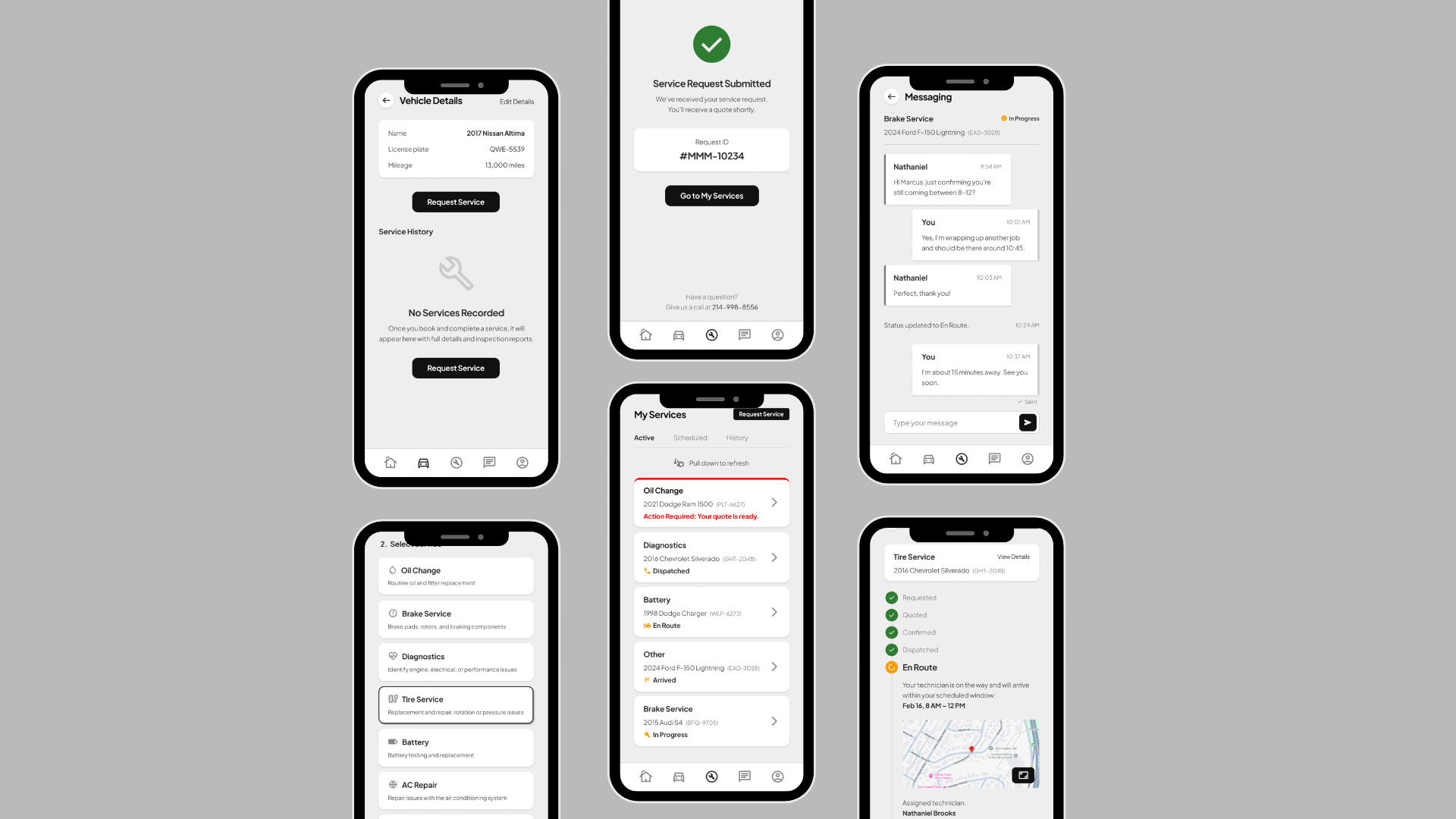
We don't have a published HVAC, plumbing, or electrical client case study to point to here, and we're not going to pretend otherwise. What we do have is direct experience building the kind of dispatch and service-request logic this problem actually requires. MMM, our on-demand mechanics platform, connects customers to field technicians through a mobile-first booking and dispatch flow built from the ground up, not configured inside someone else's template. The trade is different from HVAC or restoration, but the underlying problem, routing a request to the right technician and tracking it through completion, is the same one a custom field service build has to solve.
FAQ
Can I just customize ServiceTitan or Housecall Pro instead of building something new?
For some gaps, yes. If the problem is a missing report or a workflow that's close to standard, configuration or an add-on module often closes it. If the problem is pricebook logic the platform structurally can't express, multi-location rollups it wasn't designed for, or compliance documentation it has no field for, customization inside someone else's platform usually means working around the tool rather than with it.
How much does custom field service software cost?
There's no fixed number, because the honest answer depends on scope. What should exist is a hard one: hours estimated up front against a defined scope, so you see projected cost before committing, rather than an open-ended retainer. Appsoluty scopes this way at $70 an hour, billed weekly against hours actually worked.
Is there off-the-shelf software for fire and water restoration compliance?
Not in the way ServiceTitan or Housecall Pro handle scheduling. Restoration-specific documentation, drying logs, moisture readings, IICRC-aligned reporting, and insurance-carrier paperwork, tends to be bolted onto generic work orders in mainstream FSM tools rather than built as a first-class workflow. That gap is exactly where a custom build or a specialized module tends to earn its cost.
How long does a custom build take versus switching FSM platforms?
Switching platforms is faster to start, usually weeks, but you inherit the new platform's same limitations if your workflows weren't the problem in the first place. A custom build takes longer up front, typically starting within days of a first call but running through discovery, scope, and phased delivery over months rather than weeks, because you're building the exact logic a platform switch can't give you.